

Blog
Flat Tire After Hitting a Curb: What to Do Next

Yes, hitting a curb can make a tire go flat, either immediately or through a leak you notice later. If the tire is flat, avoid continuing on it. Stop somewhere safe, then use an appropriate spare according to your vehicle’s instructions or arrange roadside assistance. A tire that still holds air can also have impact damage.
Flat now, losing air later, or still inflated?
| What you notice | What to do next |
|---|---|
| Flat tire, rapid air loss or difficulty controlling the car | Stop in a safe place. Arrange assistance if changing a spare would expose you to traffic or cannot be done as the vehicle manual specifies. |
| Pressure falls after the impact, even without a visible hole | Have the tire and wheel checked for the source of the leak. Repeatedly adding air does not identify or repair the damage. |
| Cut, bulge or wheel damage while the tire remains inflated | Do not use normal pressure as proof that it is safe. An outward sidewall bulge needs replacement; other suspected impact damage needs professional assessment. |
For visible injury without a flat, see cuts or damage after hitting a curb. An outward bubble in the tire sidewall requires a different decision from a repairable tread puncture.
Why a curb strike can cause air loss
The impact may injure the tire, damage the wheel where it supports the tire, or affect the sealing area. The bead is the part of the tire that seats against the wheel. A tire shop can also test the valve and other possible leak locations instead of assuming that every post-impact flat is a hole in the tread. Michelin’s tire guidance describes these leak locations and the need to inspect suspected internal damage.
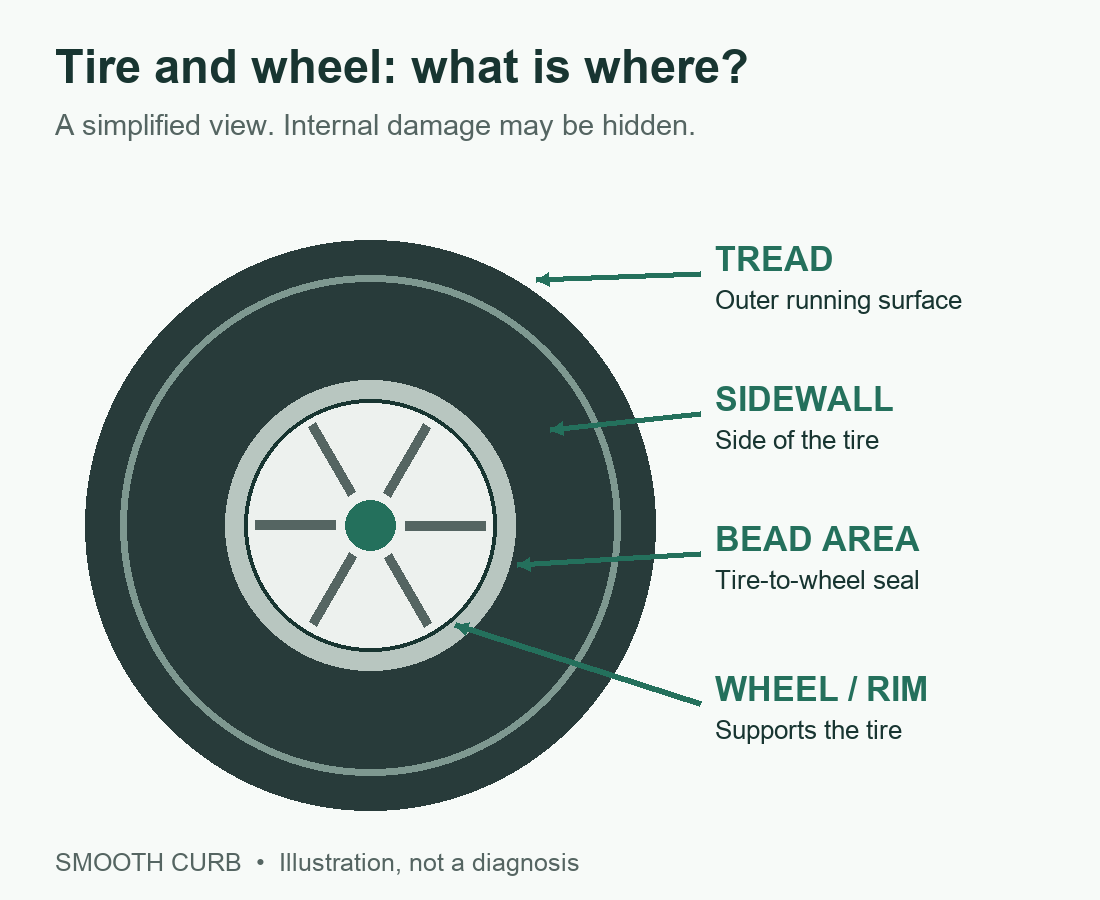
Air loss may be sudden or gradual. NHTSA’s tire guidance identifies curb impacts as a cause of pressure loss and explains why regular pressure checks matter. A tire-pressure warning system does not replace an inspection after a suspected damaging impact.
What a tire shop should inspect
Tell the technician which wheel hit, whether air escaped immediately, how the pressure changed and whether you drove after the tire went flat. Ask for the leak source and the condition of both the tire and wheel to be established before agreeing to a repair.
An exterior check alone cannot rule out all impact damage. Removing the tire from the wheel lets a trained technician examine its interior and determine whether repair is appropriate. A wheel assessment should also establish whether deformation or damage affects the tire’s seating surface. If the car now pulls or vibrates, report that separately so steering, wheel and suspension checks can be considered.
Can the flat tire be patched?
Sometimes a tire has an eligible tread puncture, but a curb-damaged sidewall is not made repairable by the injury being small. USTMA’s passenger and light-truck tire repair criteria limit repairs to qualifying punctures in the tread, no larger than ¼ inch (6 mm), without shoulder involvement. The tire must be removed and inspected; an approved repair fills the injury and seals the inner liner with a patch. Manufacturer restrictions also apply.
A plug pushed in from outside, sealant or a homemade attempt to reseat the bead is not a substitute for that assessment. Tire mounting requires suitable equipment and trained personnel. If the impact has damaged the tire’s structure, replacement is the relevant option.
What affects the repair or replacement quote?
Ask for an itemized quote identifying the tire size and specification, tire versus wheel work, mounting and balancing, valve work if needed, and any inspection or alignment work. Replacement matching requirements depend on the vehicle, particularly where tire circumference matters to the drivetrain. Check its instructions rather than assuming either one tire or all four must always be replaced.
Road-hazard and insurance coverage depend on the actual terms and the assessed damage. Check your documents or provider before assuming that a curb strike is covered.
Questions after a curb-related flat
Why is the tire flat if I cannot see a hole?
The leak may be at an area you cannot see, including the inner sidewall, bead seal or valve. A professional leak test and inspection can identify it.
Can a bent rim make a tire lose air?
Wheel damage can affect the seal between the tire and wheel. Whether the wheel can be repaired or needs replacement depends on its condition and applicable manufacturer requirements.
Can I drive on a run-flat tire after hitting a curb?
Run-flat operating limits depend on the tire and vehicle instructions. Those limits do not establish that an impact-damaged tire is safe, especially if it has a bulge, cut or wheel damage. Arrange assistance when its condition is uncertain.
What if the tire goes flat the next morning?
Report the curb impact and the delay to the tire shop. The timing can help the inspection, but it does not by itself establish where the leak is or whether the tire is repairable.
Flat in the driveway: what to do before the shop
Leave the car where it is. Driving on an ordinary flat, even to the end of the street, grinds the tire against the wheel and can turn a repairable tire and a good rim into two replacements. Check the owner’s manual for what you have: a spare, a mobility kit, or run-flat tires, each with its own rules. A mobility kit is for emergency use only and comes with speed and distance limits; run-flats have their own limits after a curb strike and should still be inspected before you trust them.
Only change the wheel yourself if the car is on a firm, level surface, you can reach the jacking points the manual specifies, and you have the tools and torque figure it calls for. A sloped driveway is not level; do not try to make it level with chocks, boards or a curb ramp, and never work under a car held up only by a jack. If any of that is not true, call roadside assistance and tell them the tire, the vehicle and that the driveway is sloped, so they bring the right equipment.