

Blog
Curb Ramps for Golf Carts: How to Check Driveway Fit

Choose a curb ramp for a golf cart by matching the cart, curb shape and tire paths. A ramp’s weight rating alone does not establish whether the cart will clear the entrance. The same driveway may need a different assessment for a two-seat cart, an extended cart or a cart with changed wheels and suspension.
This guide concerns a golf cart crossing a driveway curb. Loading a cart onto a truck or trailer requires equipment designed for that separate job. Smooth Curb’s driveway ramp is intended for rolled curb-and-gutter transitions.
Table of Contents
Start with your golf cart’s actual configuration

Start with the make, model, year and exact configuration. Use the matching owner’s manual and ask the cart manufacturer or its authorized dealer when specifications are unclear. Club Car, for example, provides an owner’s manual portal and parts, service and approved-tire resources. Use the equivalent resources for your own brand.
Clearance and wheelbase
Do not assume every golf cart has the same clearance. Club Car’s Onward 4 Passenger specifications list different clearance and wheelbase dimensions for lifted and non-lifted versions. They also distinguish front and rear wheel spacing. These are examples of configuration differences, not approval of either cart for a particular ramp.
Record the cart’s wheelbase and identify its lowest relevant parts, including any added steps, rear-seat equipment or accessories. Have the dealer help assess clearance in the intended, permitted loaded condition if you cannot establish it safely. Do not crawl under the cart or drive into a known contact point to collect measurements.
Tires and front and rear wheel spacing
Record the tire size on the cart and any changes from its original equipment. Confirm the appropriate tire specification and pressure with the manufacturer. A wheel’s advertised diameter is not the tire’s outside diameter, and a front track-width figure alone does not describe the space occupied by all four tires.
For the ramp, the useful measurement is the area the tires need to cross at the entrance, including the rear tires and turns. Changing wheels, tires or suspension calls for a fresh fit assessment; it is not a recommended workaround for a poor curb match.
Passenger load, cargo and vehicle condition
Ask the dealer to confirm the cart’s operating weight and permitted passenger and cargo load for its actual battery, powertrain and accessories. Include the intended occupants and cargo when comparing the total with ramp specifications. Do not treat a cart’s payload rating as its total weight or assume a brochure weight represents a modified cart.
A ramp does not increase the cart’s seating or load limits, repair worn suspension, or override the manufacturer’s terrain, slope and operating restrictions. Resolve a vehicle-condition concern with its service provider before assessing access.
Check a driveway ramp against your entrance
Use the driveway-curb measuring guide and worksheet with the cart parked out of the way. Record rise and available front-to-back space at several points, then assess the proposed placement against the actual curb profile.
1. Match the curb profile
Smooth Curb is designed for a rounded or sloping driveway curb, not a sharp vertical step. Its published dimensions are 12 feet along the curb, 17 inches front to back and 3 inches high. These describe the product, not a guaranteed curb-height range.
2. Compare the complete purchase
Compare the full system, any extensions and the purchase terms before deciding. Check the current Smooth Curb kit details against your measurements. Do not budget on an assumed reduction in golf-cart repairs or maintenance: this guide does not establish those savings.
3. Confirm where a ramp may be placed
Check placement requirements with the property owner and, where applicable, the municipality or HOA. This matters for shared entrances, golf-course property and public gutters. A removable ramp does not itself establish permission.
4. Locate any existing contact point
If the cart already scrapes, identify where the contact occurs from existing observations or photographs. A ramp at the gutter does not change a separate driveway crest or garage threshold. Ask for help if the location is unclear; do not recreate a scrape as a test.
5. Assess each vehicle separately
A golf cart and a car sharing one entrance need their own clearance and path checks. A large capacity figure does not prove either will fit. The ramp’s load rating and the vehicle’s permitted load are separate limits, and neither establishes traction or clearance.
6. Plan assembly and handling
The complete Smooth Curb system weighs 128 pounds. Review the assembly and placement instructions and plan for handling the sections and accessing the supplied connecting hardware. Do not assume it is a lightweight, one-person setup.
7. Review care and warranty terms
Smooth Curb includes a three-year limited warranty; review its terms before buying. Follow the product’s care instructions and address movement, damage or loose connections. No universal service life or promise to outlast the cart is established here.
8. Check drainage and surface conditions
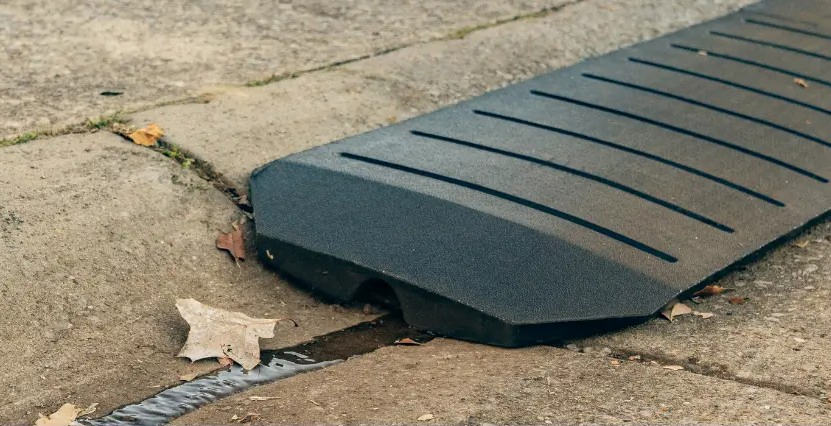
The channel provides a path for gutter water beneath the ramp. Leaves, sediment and placement still matter. Keep the channel and nearby gutter clear, following the manufacturer’s instructions when moving sections for cleaning. A drainage channel does not guarantee a dry entrance or tire grip.
9. Cover the golf cart’s full tire paths
Assess the full area crossed by the cart’s front and rear tires when entering and leaving, including turns. Overall cart width and a straight-line approach alone are not enough to choose coverage. Describe the intended route in the fit request rather than trying an uncertain crossing.
Each Smooth Curb center extension adds four feet along the curb. It does not change ramp height or front-to-back depth. More coverage cannot correct an incompatible curb profile.
What to send for a golf-cart fit assessment
- Cart make, model, year, seating arrangement and any wheel, tire, battery, suspension or accessory changes.
- The matching specifications and permitted load information, plus the normal passenger and cargo use.
- A side view of the curb, a full entrance photograph, and rise and space measurements at several points.
- The area needed for front and rear tire paths, including turns, and the location of any known scrape.
Send the Smooth Curb team these golf-cart and driveway details before ordering if fit is uncertain. For the cart’s operating limits or a modification, obtain guidance from its manufacturer or authorized dealer. A fit discussion should resolve the specific entrance questions, not promise damage-free use in every condition.