

Blog
Best Driveway Curb Ramp for Lowered Cars (2026 Guide)

The best driveway curb ramp for a lowered car is one that fits the curb and gives that specific vehicle enough clearance through the transition. Ground clearance, front overhang, suspension changes, and driveway shape all matter. A car model name or a ramp’s weight rating cannot settle the fit question on its own.
This is a buying guide from the Smooth Curb team, focused on our rubber ramp for rolled curbs. Use the checks below before ordering, particularly if your car has an aftermarket splitter, lowered suspension, or a driveway that changes slope sharply.
Find out where the car makes contact
Start with the location of the scrape, not a product recommendation. With the car parked safely away from the entrance, inspect the driveway transition and any existing marks. Do not deliberately scrape the car to diagnose the problem.
| Where contact happens | What to check |
|---|---|
| Front lip at the gutter or curb | Curb profile, front overhang, and the transition before the front tires climb |
| Underside near a crest farther up the driveway | The change in slope beneath the middle of the car; a curb ramp may not address this location |
| Rear bumper or exhaust when leaving | The rear overhang and departure path as the rear tires cross the transition |
If you cannot identify the contact point, get help assessing it before buying. An observer should stay clear of the vehicle’s path; never put anyone underneath a moving vehicle.
Check more than ground clearance
A low front lip that extends well ahead of the tires can reach a rising surface before the tires lift the car. This is why front overhang and approach geometry matter alongside the measured gap beneath the vehicle. The rear of the car has a similar clearance question when leaving.
Use the actual vehicle configuration you drive. Suspension modifications, wheels and tires, added bodywork, and vehicle load can affect clearance. Factory specifications for another trim or an unmodified example are not a reliable substitute. If your vehicle has a lift function, follow its owner’s manual and assess the driveway in the configuration you intend to use.
Match the ramp to the curb profile
Smooth Curb is designed for a rolled curb, where the gutter rises toward the driveway with a rounded or sloping profile. It is not a loading ramp, a replacement for driveway grading, or a universal solution for a tall vertical curb.
Measure the rise from the gutter to the driveway edge and the available front-to-back space at several points. Take side-view photos that show the gutter and driveway together. Compare the measurements with the ramp dimensions and ask us about unusual profiles, curves, or uneven surfaces. Our eight-step ramp selection guide covers these measurements in more detail.
What the Smooth Curb system provides
The standard Smooth Curb driveway ramp consists of three connected sections made from 100% recycled rubber. The listed dimensions are 144 inches along the curb, 17 inches front to back, and 3 inches high. A hollow center channel is designed to allow water to pass underneath.
The 12-foot span is coverage along the curb, not the distance the car travels from the street toward the driveway. Each 4-foot center extension widens that coverage: one makes a 16-foot system, and two make a 20-foot system. Extensions do not change the ramp’s height or front-to-back profile.
These dimensions help you compare the product with your entrance. They do not guarantee that a particular splitter, exhaust, or underbody will clear it.
Plan coverage, drainage, and installation
Consider both entry and exit paths when choosing the total span. If you routinely turn across the entrance, check the tire paths rather than assuming a standard kit covers the entire driveway. Keep travel within the ramp’s installed coverage.
Follow the assembly instructions for positioning the sections and securing the connecting bolts. Check that the ramp seats properly and that its drainage channel is clear. Recheck the placement and channel during routine maintenance. Disconnect the sections before moving the system.
Confirm any applicable placement requirements with your municipality, HOA, or property owner. Removability alone does not establish permission to occupy a curb or gutter.
Installation photos and owner reports
These existing Smooth Curb product photos show a curb transition before and after the ramp is positioned. They illustrate the entrance change; they are not photographs of the reviewers’ driveways below.
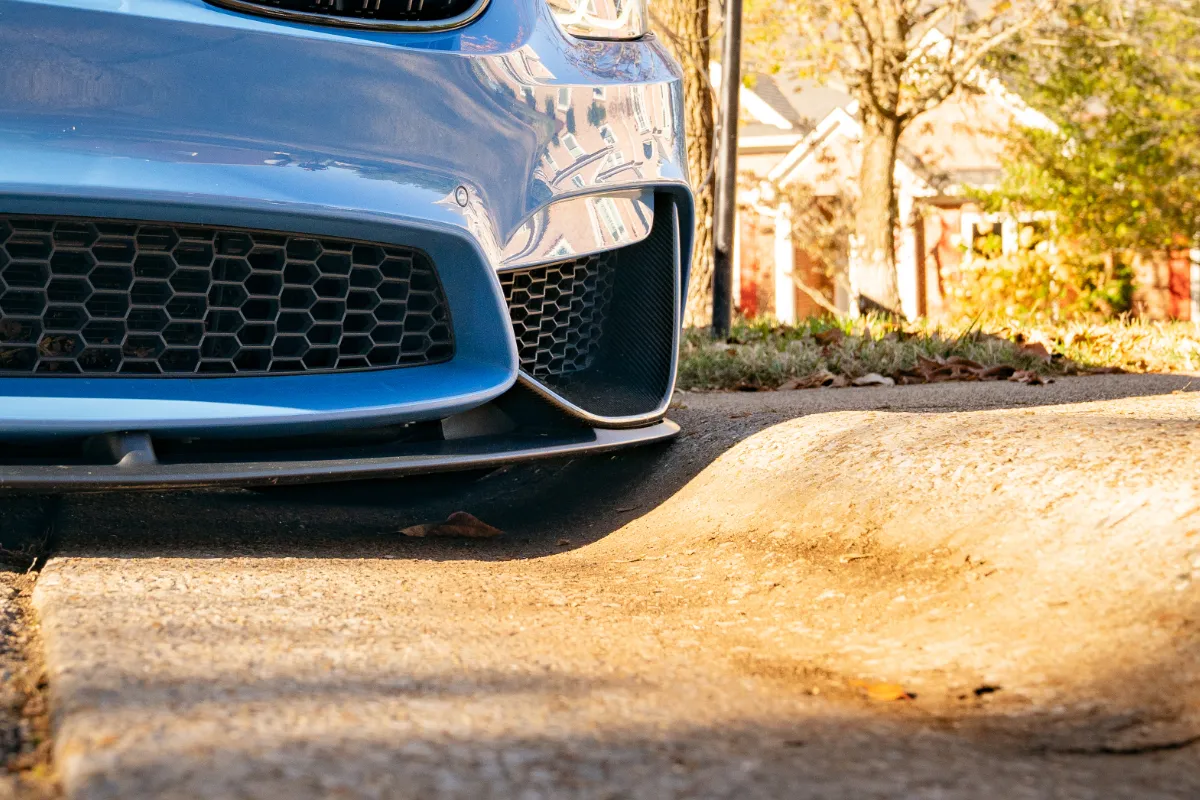
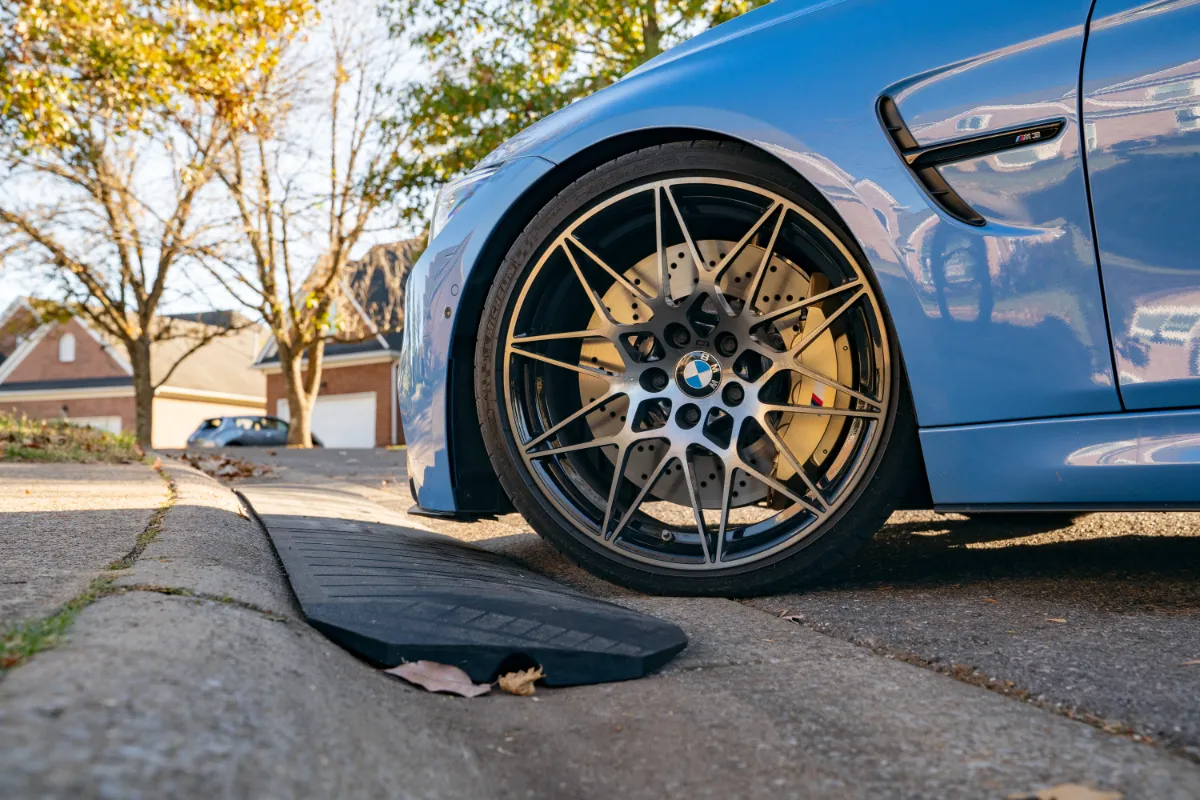
A Chevy Volt owner describes the curb and result
In an April 22, 2026 review, Grant Sautner described a low-clearance Chevy Volt and a curb he measured at five inches. He reported: “we no longer hit the curb.” This is the owner’s account, not a measured product fit test.
A Corvette owner reports less scraping
Mick wrote on July 24, 2024: “Installed easy. My Corvette doesn’t scrape anymore!” The review does not specify curb dimensions or suspension configuration.
Read these accounts in the original product reviews. Neither review is marked as a verified purchase in our review system. Results at one entrance do not establish clearance at another; use the measurement checks above for your own car and curb.
Decide whether to order or ask for a fit check
A rolled curb, a scraping point at the gutter, and a compatible ramp profile are useful starting points. A sharp driveway crest, an irregular surface, or very limited clearance deserves a closer assessment before purchase.
Contact Smooth Curb with the curb rise, front-to-back space, desired coverage width, side-view photos, and details of the car’s modifications. Explain where it currently scrapes. This gives our team more useful information than the car model alone.
Before ordering, review the current product price, shipping FAQ, and return policy. Free shipping is available within the contiguous United States. Account for any extensions and review return shipping and restocking terms as part of the purchase decision.
How a ramp changes the approach, and what it can’t change
A rolled curb is a short, steep hump. A ramp fills the gutter in front of it so the tires start climbing earlier and the bumper meets a shallower slope. That is the whole mechanism. It works when the contact point is at the curb transition and the curb is a rounded profile the ramp can sit against. It does nothing for a crest further up the driveway, a garage lip, or a car that is scraping because the front overhang is long and the splitter sits an inch off the ground everywhere. Very low cars, roughly under three inches at the front lip, may still touch even with a correctly fitted ramp, which is why we ask for photos before you order rather than after.
Getting a lowered car in and out until the curb is fixed
Approach at a crawl with the suspension settled, not compressing. Take the curb on a slight diagonal so one front wheel climbs first, which roughly halves the step the bumper sees. Do not turn the wheel while the front is on the hump. Check both directions, because backing out puts the departure angle in play and the rear diffuser or exhaust becomes the low point. If the car has a lift kit or air suspension, use it as the manual describes. Skid plates and lip guards protect the part that touches; they do not stop it touching. And keep tires at the placard pressure: a soft tire lowers the car and moves the rim closer to the edge.
Why a homemade ramp usually isn’t the answer
Boards, sandbags, cold-patch asphalt and loose rubber mats all get tried. The problem is not strength, it is that they move. Anything that is not heavy enough to stay put under a turning tire, or bolted into one piece, walks out of position within a few weeks and ends up in the gutter. Poured asphalt against a curb is usually against city rules because it blocks drainage and is on public right-of-way. If you want a DIY solution, the durable versions are concrete work with a permit, which is a different project from a ramp.
Questions about ramps for lowered cars
Will it work with a Corvette, Porsche, Mustang, or modified daily driver?
Those names alone do not establish fit. Compare the actual car, its modifications, the contact point, and the curb profile. A successful installation for another owner is useful context, but it does not guarantee clearance at your driveway.
Will a wider ramp solve a front bumper clearance problem?
More sections increase coverage along the curb. They do not make the front-to-back transition longer or change its height. Check the profile first, then choose the width.
Can a curb ramp fix scraping halfway up a steep driveway?
A ramp at the street changes that entrance transition. It does not change a separate crest farther up the driveway. Identify the contact point before deciding what needs to change.