

Blog
Why Do I Keep Hitting Curbs? Turning and Parking Tips

Repeated curb contact often comes from misjudging the car’s position, using a reference point that does not fit the vehicle, or forgetting that the rear wheels follow a different path in a turn. Start by identifying which wheel hits and during which maneuver. A rear-wheel strike while turning needs a different correction from approaching a curb too closely while parking.
Which wheel hits, and when?
| When contact happens | What to work on |
|---|---|
| Inside rear wheel catches the curb on a forward corner | Rear-wheel tracking and adequate clearance through the turn, within lawful lane positioning. |
| Front wheel touches while pulling alongside | Approach angle, speed and judgment of the vehicle’s side clearance. |
| A wheel contacts during parallel parking | The particular reversing stage, steering timing and reference points for that vehicle. |
| Bumper or underside scrapes at a driveway | The entrance profile and vehicle clearance; this is different from street-parking distance. |
Notice whether the pattern began after changing cars, seat height or mirror settings. Those changes can alter what the curb looks like from the driver’s seat. Rushing or concentrating on only one mirror can also leave too little time to stop and correct the position.
Why rear wheels cut inside the front-wheel path
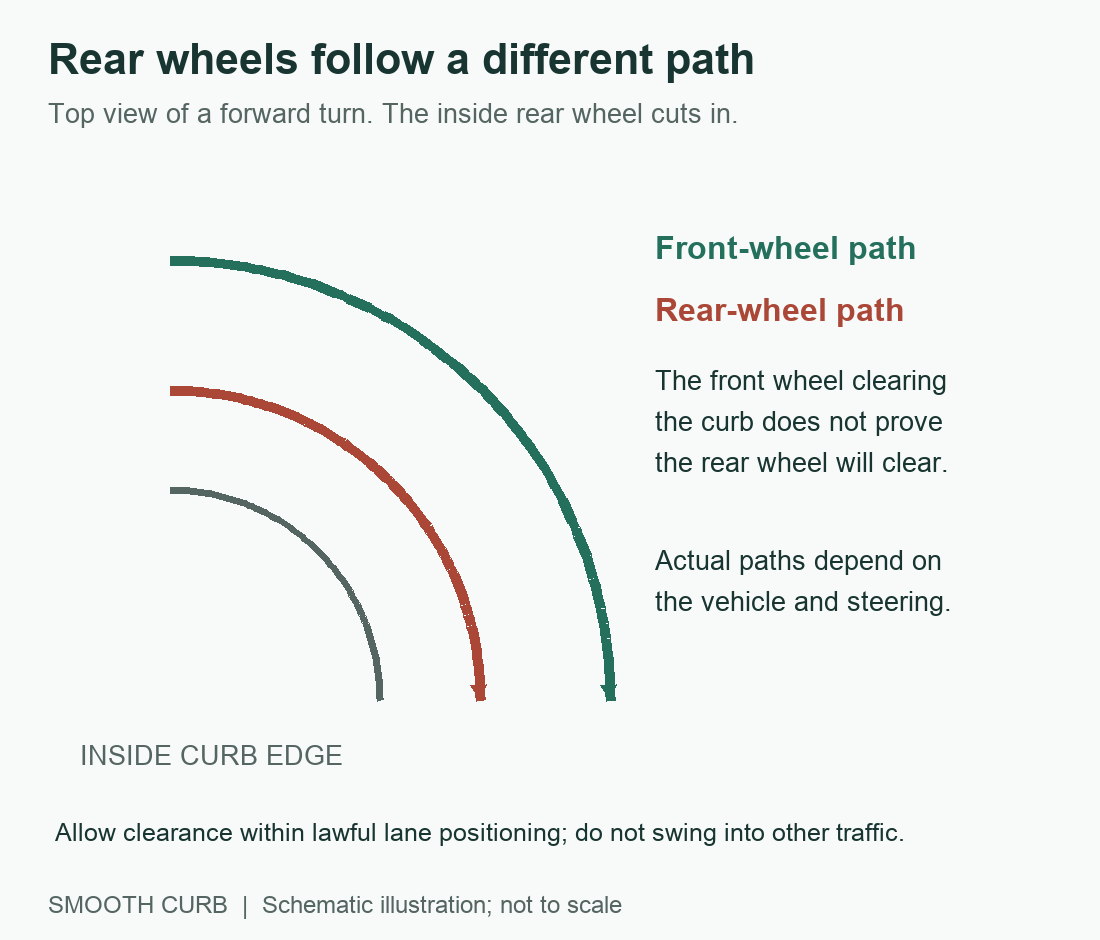
During a forward turn, the inside rear wheel follows closer to the inside of the corner than the front wheel. The front tire clearing the curb does not prove that the rear tire will clear it. The California DMV training glossary calls this difference in wheel paths offtracking.
Turning circle describes how tightly the vehicle can turn; it is not the same as clearance for the inside rear tire. One rear-wheel strike does not diagnose an unusually wide turning circle. Allow room for the entire vehicle’s path while following the required lane position, watching for pedestrians and other road users, and avoiding a swing into adjacent traffic.
Pulling alongside, parallel parking and turning a corner
Pulling alongside: check that stopping is permitted, observe and signal as appropriate, and approach under control. Judge the whole side of the car instead of steering toward a single point on the curb. Coastline Academy’s curbside-parking lesson demonstrates the sequence of observation, signaling and positioning.
Parallel parking: watch the vehicle’s position throughout the reversing maneuver. If clearance becomes uncertain, stop and reassess when safe. A fixed instruction such as “turn when the mirror crosses the curb” cannot fit every car, seat position and parking space. Learn the sequence in your vehicle with an instructor if repeated contact continues.
Turning a corner: account for the rear-wheel path as well as the front. Begin from the lawful position for that turn and maintain clearance without entering another lane to create space. If the available space is unclear, do not force the maneuver past a curb or another road user.
Practice reference points for your own car
Use an authorized, empty practice area with soft markers instead of a real curb or rigid obstacle. Pick one maneuver to practice. A consistent seat and mirror position makes observations easier to compare.
| Practice step | What to do |
|---|---|
| 1. Set up and observe | With the vehicle parked securely, position soft markers to represent the edge. Check the surroundings and identify the view from your normal seating position. |
| 2. Approach and stop | Move at a low, controlled practice speed. Stop before clearance becomes uncertain; keep watching the whole area rather than staring at one marker. |
| 3. Compare and repeat | Secure the vehicle and, when safe, get out to compare the actual gap with what you saw. Adjust the reference and repeat the same maneuver before changing the setup. |
The point is to connect your view from the seat with the car’s actual position. It is not to discover the closest possible clearance or practice hitting the marker. Keep people away from the vehicle’s path, and stop the session if the area becomes busy. If the pattern persists, a driving instructor can observe the exact wheel and maneuver involved.
How much space should I leave from the curb?
Learn the parking requirement for your location; there is no single worldwide distance rule. Leave clearance while complying with the applicable maximum distance and signs. Our curb meaning and parking guide explains the terms and gives clearly labeled California examples.
Do not use contact with the curb as your stopping cue. If you cannot judge the gap, a safe stop and reassessment is preferable to continuing until a tire touches. Recheck your reference points when driving a different vehicle or changing the seating position.
Cameras and parking sensors have limits
Use cameras and sensors as supplements to observation. Capabilities depend on the vehicle and conditions; do not assume they detect every low curb. NHTSA’s driver-assistance guide distinguishes warning and assistance features and the driver’s continuing responsibilities. Read the specific system’s instructions rather than treating a quiet sensor as proof of clearance.
What to do if you hit the curb again
Stop safely and use our post-impact tire, wheel and underside checklist before resuming practice. Note the wheel and the stage of the maneuver so the next lesson addresses the actual problem. A driveway ramp may help a suitable rolled-curb crossing, but it is not a parking-distance guide or a way to prevent street-corner collisions.
Questions about parking and avoiding curbs
Why does the rear wheel hit when the front wheel clears?
In a forward turn, the inside rear wheel tracks inside the front-wheel path. Clearance must account for that path while maintaining lawful positioning and checking other road users.
Can I use the same reference point in every car?
No. Vehicle dimensions, seating position, mirrors and the maneuver change the view. Practice and verify references for the vehicle you are driving.
Should I start farther left before every right turn?
Do not adopt a blanket instruction to shift left or swing into another lane. Use lawful turn positioning and appropriate clearance for the whole vehicle; get instruction if you cannot complete the maneuver reliably.
Will parking sensors stop me hitting the curb?
They cannot be assumed to detect every curb or stop every contact. Understand your vehicle’s system and continue observing the space and vehicle position.