

Blog
Tire Damage from Hitting a Curb: Cuts, Bulges and Next Steps

After hitting a curb, check for tire cuts, torn rubber, exposed cords, an outward bulge, air loss and visible wheel damage. A tire can still hold air despite an impact injury. If it has a bulge, exposed reinforcement, rapid air loss or damage you cannot assess, arrange professional help rather than using its appearance as clearance to keep driving.
Does hitting a curb damage your tires?
It can. A curb may scrape the outside of the tire or injure deeper material when the tire is compressed against the wheel. The impact history matters even if the visible mark seems small. Michelin’s tire guidance explains that suspected internal damage may require removing the tire for inspection.
Stop where you can look without standing in traffic. Record which wheel struck the curb, photograph the visible damage from a safe position and note any pressure warning. Do not peel back loose rubber, probe a cut, glue a flap down or get beneath the vehicle to inspect the inner sidewall.
A cut, scuff or bulge: what are you looking at?
| Observation | What it tells you |
|---|---|
| Rubbed or scuffed surface | It shows contact. It does not establish how much material was affected or whether there is hidden damage. |
| Cut, tear or missing rubber | Have the injury assessed. There is no universal visible cut depth that establishes safe continued use. |
| Exposed cords or an outward bubble | These are serious signs of structural damage. Arrange assistance and replacement assessment. |
| Flat tire or continuing pressure loss | The tire and wheel need leak inspection. See the flat tire after hitting a curb guide. |
| Bent or damaged wheel edge | Have the wheel, bead seating area and tire checked together. |
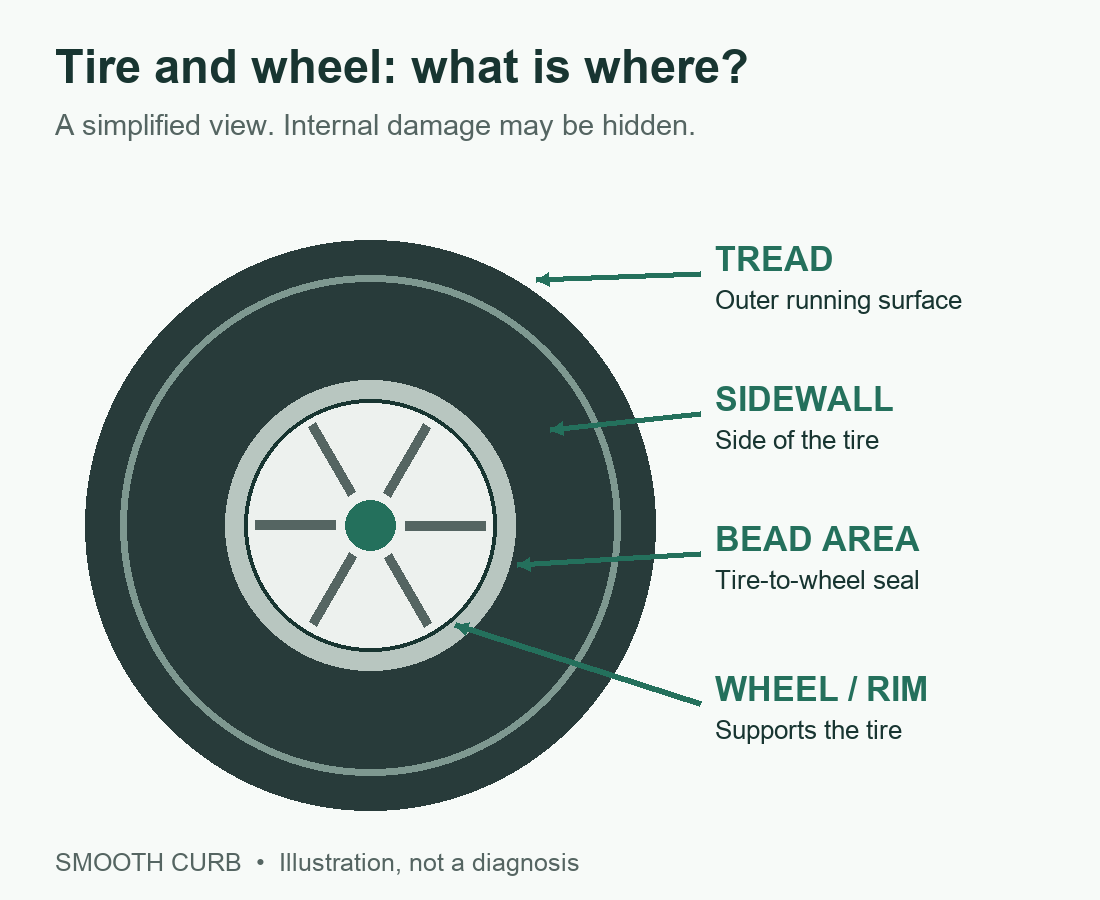
Continental’s tire-damage guide directs tire cuts to expert inspection and distinguishes them from normal construction indentations. For an outward shape rather than a cut, see our tire sidewall bubble guide. A photograph can help describe the problem, but it cannot reveal the complete condition of the tire.
Can you still use the tire if it holds air?
Holding pressure is one observation, not proof of structural safety. The inside of the tire and the side facing the vehicle may not be visible during a roadside look. A pressure warning system also cannot diagnose a cut or damaged reinforcement.
If you are uncertain about an impact injury, ask a tire professional to establish whether it can remain in service. Tell them about driving on low pressure after the impact. Do not wait for a damaged-looking tire to go flat before taking the concern seriously.
What professional inspection should cover
The technician should match the inspection to the incident: examine the visible injury, check the tire’s interior when required, assess the bead and wheel, and investigate any air loss. Ask what was found and whether the proposed decision is continued use, a qualifying tread repair or replacement.
A small sidewall cut is not made patchable by being below a tread-puncture size limit. USTMA’s repair criteria allow only qualifying tread punctures, no larger than ¼ inch (6 mm), without shoulder involvement and after removal and inspection. A proper eligible repair fills the injury and seals the inner liner; manufacturer restrictions still apply.
For replacement, ask the shop to follow the vehicle’s tire specification and matching requirements. Wheel damage must be assessed separately: replacing a tire alone does not correct a damaged seating surface or other wheel problem.
What if the car pulls or vibrates afterward?
Report new pulling, vibration or changed steering to the repairer. A curb strike can call for checks beyond the visible tire injury. Uneven wear is more useful as a longer-term clue than as proof of a fresh cut; alignment problems can contribute to wear over time, as Continental explains.
For broader impact symptoms, read what to check after accidentally driving over a curb. Keep the tire decision tied to its actual inspection rather than assuming every curb strike has damaged the same set of vehicle parts.
Questions about a tire cut after hitting a curb
I hit a curb and my tire has a cut. Can I glue it?
Glue does not restore damaged tire reinforcement or establish whether the cut is safe. Have the actual injury inspected instead of treating the loose rubber as the only problem.
How much sidewall damage is acceptable?
There is no universal photo-based or millimeter rule that clears a sidewall injury for use. Depth, location and internal condition matter; an inspection must establish the tire’s condition.
Is a chunk missing from the rim protector always harmless?
No blanket conclusion can be made from the description. A tire professional needs to distinguish damage to that raised rubber area from damage extending into the sidewall structure.
The four kinds of curb-strike tire damage, and which ones are repairable
| Damage | What you see | Repair or replace |
|---|---|---|
| Tread puncture | Object embedded in the tread, or slow loss of pressure | Repairable if it is in the tread area, within the size limit, and the shop plugs and patches from inside. Outside-only plugs do not count. |
| Sidewall cut or scuff | Sliced or torn rubber on the side of the tire; cords may show | A surface scuff with no cord showing is usually cosmetic. Anything that exposes cord is a replacement; sidewalls cannot be patched. |
| Sidewall bulge | A bubble or lump on the side, sometimes not until a day later | Always replace. The internal cords have broken and the tire can fail without warning. Stop driving on it. |
| Bead damage | No visible mark, but the tire loses air slowly; sometimes a bulge near the rim | The bead is the reinforced edge that seals against the wheel. A nick or tear there is a replacement on passenger tires; bead sealer does not restore it. |
Two things a curb strike does that a nail does not: it can damage the tire from the inside without leaving an outside mark, and it can damage the wheel at the same time. A slow leak that starts after a curb hit is as likely to be a bent rim flange or a cracked bead as a puncture, which is why the tire has to come off the wheel to be inspected properly.
If it’s losing air slowly
Record which tire, the cold pressure reading, and the date, and check again the next morning before driving. A tire that drops a few psi overnight after a curb hit needs to come off; the tire-pressure warning light only comes on after a significant loss, so waiting for it is waiting too long. Spraying soapy water on the tire will show you where air is escaping, but it will not tell you whether the tire is structurally sound, so treat it as a way to describe the problem to the shop rather than a diagnosis. Do not assume the leak is small because you cannot hear it.
What makes sidewalls the weak point
The sidewall is the thinnest part of the tire and has no tread to absorb a blow. When a wheel meets a curb, the sidewall is pinched between the curb edge and the rim, and the cords inside can snap even when the rubber outside looks fine; that is what a bulge is. Underinflation makes it worse, because a soft tire flexes more and the rim sits closer to the curb. Heat softens the rubber and cold makes it brittle, and tires more than six or seven years old crack more easily. Low-profile tires have less sidewall to begin with, so the same curb does more damage to them, and to the rim behind them.