

Blog
Lowering Your Car: Clearance, Suspension and Fit Checks

Before lowering your car, check whether the proposed suspension setup will work with your vehicle, everyday roads and driveway. A smaller wheel gap is easy to see; usable suspension travel, tire clearance and the checks needed after installation require more than a photograph.
Use this guide to prepare a discussion with a qualified suspension specialist before buying parts. It is a decision guide, not a spring-removal or installation procedure.
Table of Contents
What to consider before lowering your car

Define the change you want
Decide whether your goal is appearance, a particular handling change, or replacing worn suspension parts. Describe the result you want and the comfort or access you need to keep. If the current car scrapes, pulls or rides poorly, have that condition assessed before choosing a lowering kit.
Ground clearance and suspension travel
Ground clearance is the space beneath the car. Suspension travel is the movement available as the wheels respond to the road. A driveway scrape and the suspension reaching the end of its travel are different problems, even though people may call both “bottoming out.”
BILSTEIN’s lowering guide identifies reduced clearance around curbs and uneven surfaces as a tradeoff. Ask the installer to assess the proposed ride height, front and rear overhangs, tire clearance and available travel as a complete setup. There is no universal drop that will clear every entrance.
Your everyday route
List the speed bumps, garage ramps, driveway crests and rough sections you use regularly. Include the passengers and cargo you normally carry within the vehicle’s limits. A setup that suits a parked display may not suit that route and load.
Do not plan around a rule that every bump must be crossed diagonally. A different approach cannot guarantee clearance and may require space you do not safely have. If clearance is uncertain, stop and reassess; repeated scraping is a reason to change the setup or route.
Ride comfort and component compatibility
Ask how the proposed springs, dampers and other required parts work together. BILSTEIN emphasizes matching spring and damper characteristics. That does not mean every lowering spring requires the same replacement damper; follow the exact application’s instructions.
For example, Eibach’s instructions for one Kia EV6 kit specify reusing the original bump stops without modification. This is a vehicle-specific example, not permission to alter or reuse parts with any kit. Avoid promises that a stiffer or lower setup automatically gives a better ride.
The complete installation estimate
Get an itemized quote for the exact parts, labor, worn components that need replacement, alignment, applicable system checks and follow-up inspection. For adjustable systems, ask about ongoing care and setup changes. A parts-only price cannot establish the cost of a completed installation.
Alignment and vehicle systems
Have the installer identify the alignment specifications and checks required at the intended driving height. Depending on the application, the work may include tire-to-body clearance, brake-line routing and affected self-leveling or electronic systems.
Eibach’s general spring-safety instructions call for professional installation and relevant post-installation checks. Ask which procedures apply to your car; a wheel alignment alone does not establish that every related system has been checked. Keep the installation and alignment records.
How to assess claimed benefits
Appearance is a preference. Handling depends on the complete vehicle and suspension setup, so ask for evidence about the particular parts and application rather than treating the amount of lowering as a performance score.
- Ask what measured or observed handling change the supplier claims for your vehicle.
- Compare that claim with the ride comfort, travel and clearance you need.
- Do not assume improved acceleration, braking, fuel economy or aerodynamics from a lower stance alone.
A comparison should also include keeping the current ride height or repairing worn original components. Those may better match your needs when access or comfort is the priority.
What the main suspension options change
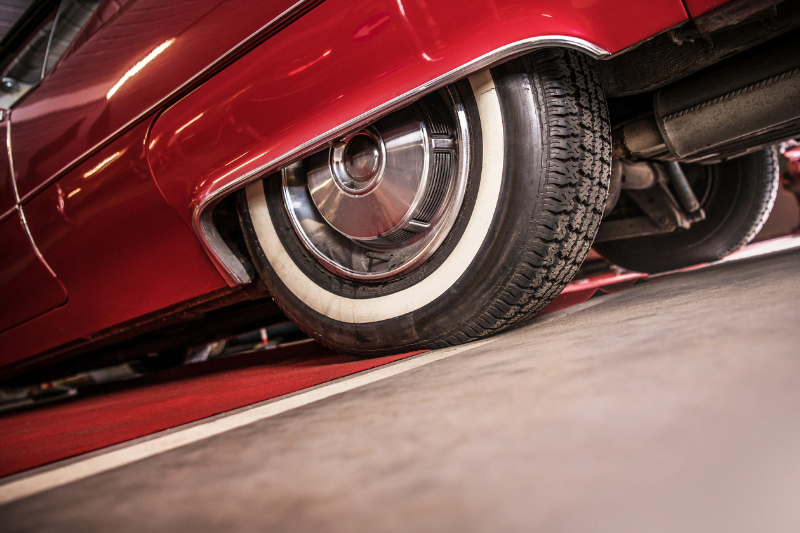
- Lowering springs: replace the springs for the specified application. Confirm compatible dampers, mounting parts and any required adjustments; do not choose by an advertised drop alone.
- Matched spring-and-damper kits: supply components selected to work together for a listed vehicle. Confirm the exact trim, drivetrain, axle-load and suspension exclusions before ordering.
- Adjustable coilovers: offer ride-height adjustment in the kit’s specified range. Damping adjustment is a separate feature: BILSTEIN distinguishes its height-adjustable B14 from its damping-adjustable B16. Check what the actual kit allows.
- Air suspension: uses air springs and a management system. Ask the installer to establish the permitted driving height, pressure limits and maintenance for the specific installation. A low parking preset is not automatically a suitable driving setting.
The Air Lift 3H/3P manual includes driving-height settings, but its configurable defaults do not establish a safe height for every vehicle. Follow the suspension kit and management instructions together.
Do not cut or heat springs to create a drop, or remove stops and protective parts to make an unapproved setting fit. Suspension springs store energy; leave removal and installation to a qualified professional using the applicable procedure.
Check the driveway before choosing a drop
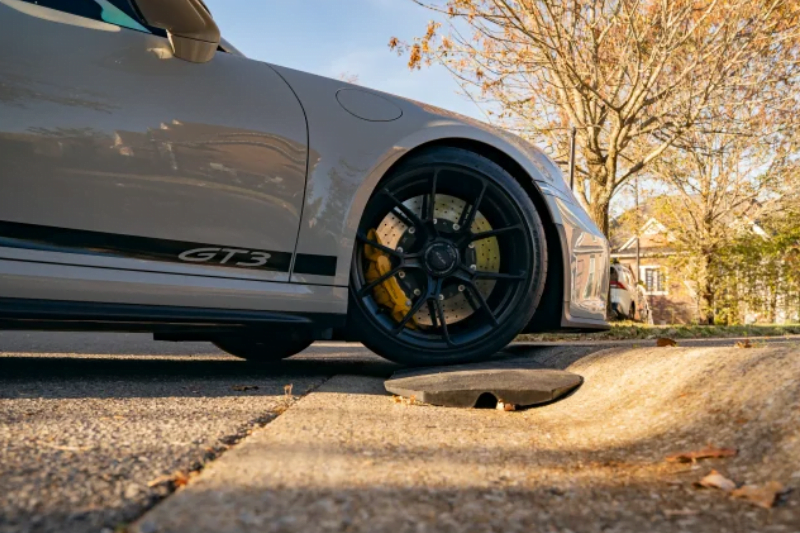
With the vehicle safely parked out of the way, record the driveway profile and any existing contact marks. Identify whether the constraint is the rolled curb at the street, a steep slope, a crest, or the garage threshold. Do not drive into an obstacle to test a proposed lower height.
The curb-measuring guide helps record the curb profile and placement space. A compatible rolled-curb ramp changes that entrance transition. It does not change the car’s suspension travel, solve a crest elsewhere or guarantee clearance after lowering.
For a car that is already lowered, the lowered-car driveway guide covers route assessment. If contact has already occurred, use the undercarriage-damage guide to prepare for an appropriate inspection.
Questions to answer before ordering parts
- Is the exact kit listed for this vehicle and its current wheel, tire and suspension configuration?
- What driving height and adjustment range will the installer use?
- Will the daily route, driveway and normal permitted load remain practical?
- What installation, alignment, system and follow-up checks are included?
- What is the complete quote, and what should happen if the finished setup does not meet the agreed requirements?
Resolve those questions before ordering. After installation, do not dismiss new rubbing, uneven ride height, warning messages or strong vibration as normal “settling.” Have the installer assess them. If control is impaired or continued use may be unsafe, stop safely and arrange assistance.
Why people lower their cars
The reasons fall into three groups, and it helps to know which one you are in before you pick parts. The first is looks: a lower stance, less wheel gap, an older car that reads as current. The second is handling: a lower center of gravity reduces body roll and can sharpen turn-in, though the gain depends on matching springs to dampers, and a badly matched drop handles worse than stock. The third is track or event use, where the car is set up for a surface that is not your street. If your reason is in the first group, a modest drop on quality springs gets most of the look with the fewest daily costs. If it is in the second, budget for dampers and alignment, not just springs.
What lowering does to your clearance angles
Lowering a car by an inch does not just take an inch off the ground clearance number. It reduces the approach angle at the front, the departure angle at the rear, and the breakover angle in the middle, all at once, and the front usually suffers most because that is where the overhang is longest. In practice a one-inch drop on a car with a long front overhang can be the difference between clearing a rolled curb and scraping it on every entry. Before you order parts, measure your curb rise and photograph the entrance from the side, so you know how much margin you are giving up.