

Blog
Scraped the Bottom of Your Car? Noise Causes and Next Steps

A new noise after scraping the bottom of your car can come from a loose underbody panel, heat shield, exhaust contact or a part near a wheel. The sound alone cannot identify the damage. Stop somewhere safe and check for warnings, leaks, hanging parts or changed braking and steering before deciding what happens next.
When to stop and arrange assistance
An oil-pressure warning, substantial fluid leak, dragging component or change in braking or steering calls for prompt attention. If the oil-pressure warning appears, stop safely and switch the engine off, then follow the owner’s manual. Ford’s oil-pressure warning instructions illustrate why continuing to run the engine is not the right way to test whether the noise disappears.
Observe from a safe standing position. Do not reach toward hot exhaust parts, moving wheels or brakes, and do not crawl underneath a car supported only by a jack. Ford’s jack safety instructions explicitly warn against that. Arrange roadside assistance if the vehicle’s condition makes continued driving or a roadside inspection unsafe.
Possible causes of noise after scraping the underside
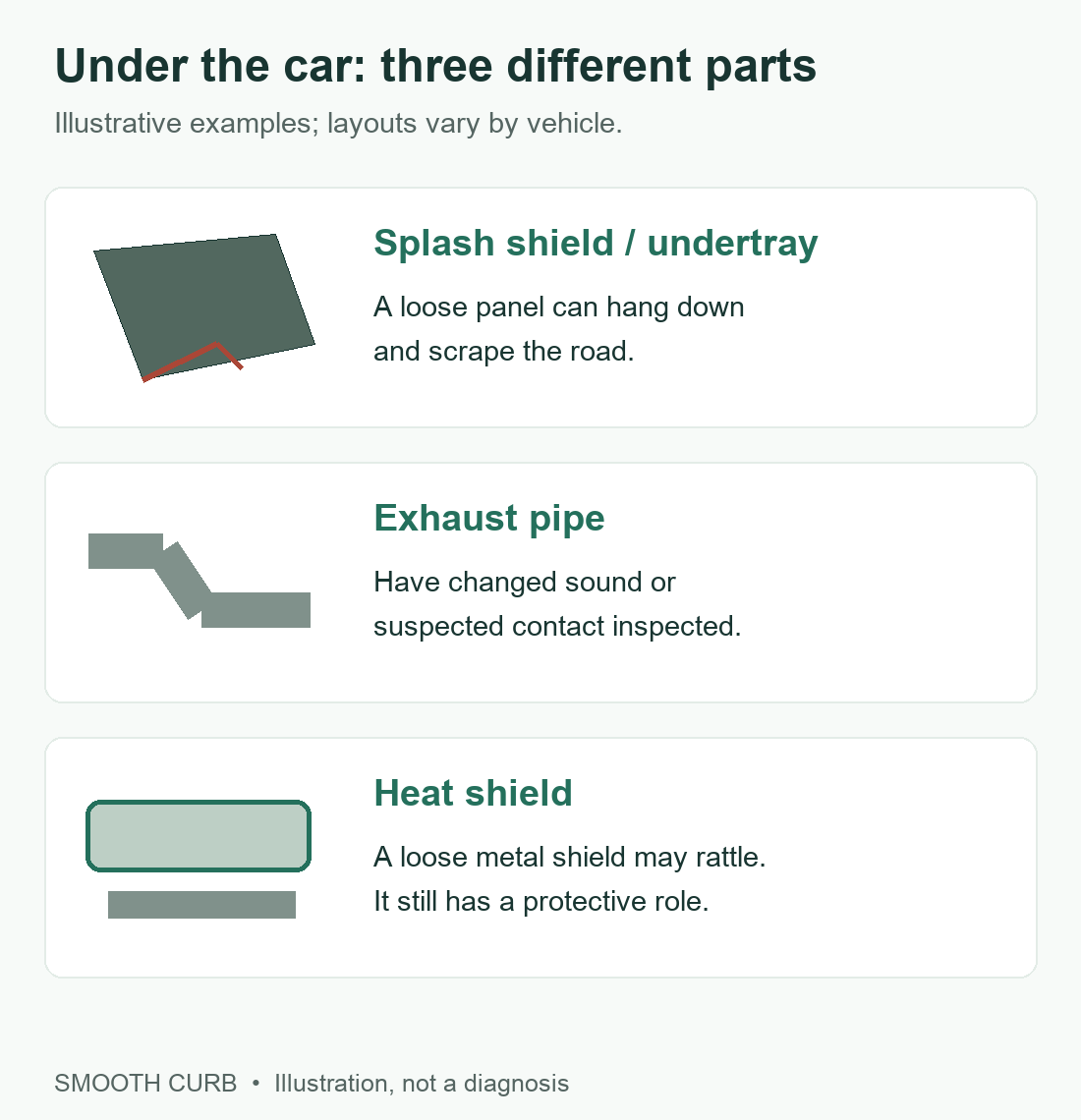
Loose splash shield or undertray. A plastic panel or its fasteners may be damaged or displaced, allowing the panel to touch the road or move as the car travels. 1A Auto demonstrates how a loose splash shield can scrape. The correct repair depends on the panel and mounting damage; cutting it away is not a universal fix.
Loose heat shield. Thin metal shields around hot exhaust components can rattle when loose. 1A Auto’s heat-shield inspection demonstration shows this type of noise. The shield has a protective purpose, so simply removing it is not an appropriate general recommendation.
Exhaust contact or damaged supports. Contact may move an exhaust component or affect how it is supported. Have a repairer check its clearance and attachments. A sound that changes with engine vibration can be useful information, but it does not prove that the exhaust is the cause.
A part near a wheel. A bent brake dust shield, trapped debris or tire contact with displaced trim can produce scraping associated with wheel movement. Marble Falls Auto Center describes these possible scraping sources. Because brake and tire issues can share similar sounds, avoid choosing a repair from the noise description alone.
What the timing of the sound can tell you
| When you hear it | What to report to the repairer |
|---|---|
| While stationary with the engine running | Whether the sound follows engine vibration. Shields, exhaust clearance and attachments may warrant inspection. |
| Only while the vehicle is moving | Whether it changes with road speed. A dragging panel or an area around a wheel may need checking. |
| During braking or turning | The exact trigger and any change in control. Brake, wheel, tire and nearby trim inspection may be needed. |
| Over bumps | Whether there is rattling, contact or a hard thump. Loose attachments and suspension-related contact are possibilities. |
These are inspection routes, not diagnoses. Do not deliberately repeat a scrape, accelerate, brake hard or keep driving to reproduce a concerning sound. Information you already observed during the incident is enough to start the discussion.
What to ask a repair shop to check
Describe the obstacle, where the vehicle made contact, whether it was loaded, when the sound began and any dashboard warning. Provide a photograph of an accessible loose part or visible leak only if taking it is safe. Tell the shop whether the noise existed before the incident.
Ask it to inspect the contact area and nearby panels, fasteners, shields, exhaust supports and other affected components. If the noise follows wheel movement or accompanies changed control, report that clearly so the inspection includes the relevant wheel, brake or suspension areas. The repair should follow the finding rather than a generic list of replacement parts.
Keep the damage assessment separate from fixing repeated clearance problems. Our car bottoming out guide explains the difference between suspension compression and road contact. For repeat contact at home, see how to investigate a car scraping the driveway once the new noise has been addressed.
Questions about a new underbody noise
Can I keep driving if the car still feels normal?
Normal-feeling handling does not identify what is making the new noise. Check for warnings, leaks or hanging parts and arrange an assessment. If a part is dragging or braking or steering has changed, stop safely and get assistance.
Will a loose heat shield stop rattling by itself?
It needs inspection of its attachments and condition. Its protective role matters; do not treat removal as the default solution.
Could gravel be causing the noise?
Trapped debris near a brake shield is one possibility, but a similar sound can come from other parts. A technician should identify the source rather than having you reach into the brake or wheel area.
Does a scrape mean the oil pan is damaged?
Not necessarily. A scrape does not establish which component was contacted. A leak or oil-pressure warning needs prompt attention, and the affected area must be inspected.