

Blog
How to Drive a Lowered Car Up a Driveway: 10 Easy Solutions

Before driving a lowered car up a driveway, assess the car as it is configured today and the whole entry and exit route. A front splitter, modified suspension or factory lift setting can make the setup different from the stock car. No steering angle or ramp height guarantees clearance for every combination.
The ten checks below help you decide what can be assessed safely, when a rolled-curb ramp is relevant, and when a vehicle specialist or driveway contractor should take over.
Table of Contents
Why driveway geometry matters for a lowered car
Look at the complete path: the street-to-curb transition, the driveway slope, any crest, and the garage threshold. The front overhang can touch before the front tires reach an incline; the center can contact a crest; the rear overhang needs clearance on departure. Ford’s owner-manual diagram illustrates why approach, breakover and departure are separate from minimum ground clearance.
Your exact model, wheelbase, bodywork, ride-height setting and normal load are more useful than a universal “safe” ground-clearance number. Start with our driveway scraping diagnosis guide if you have not identified where the contact occurs.
10 checks before using the driveway
1. Assess the route in both directions
Review visibility, driveway width, the entrance shape and space needed to enter and leave. An angled route changes the path but does not guarantee clearance. Only consider a route that stays within a safe, permitted driving area and gives way to pedestrians and traffic. If you cannot establish a usable path, arrange an assessment instead of experimenting through repeated contact.
2. Check whether the curb is a suitable ramp application
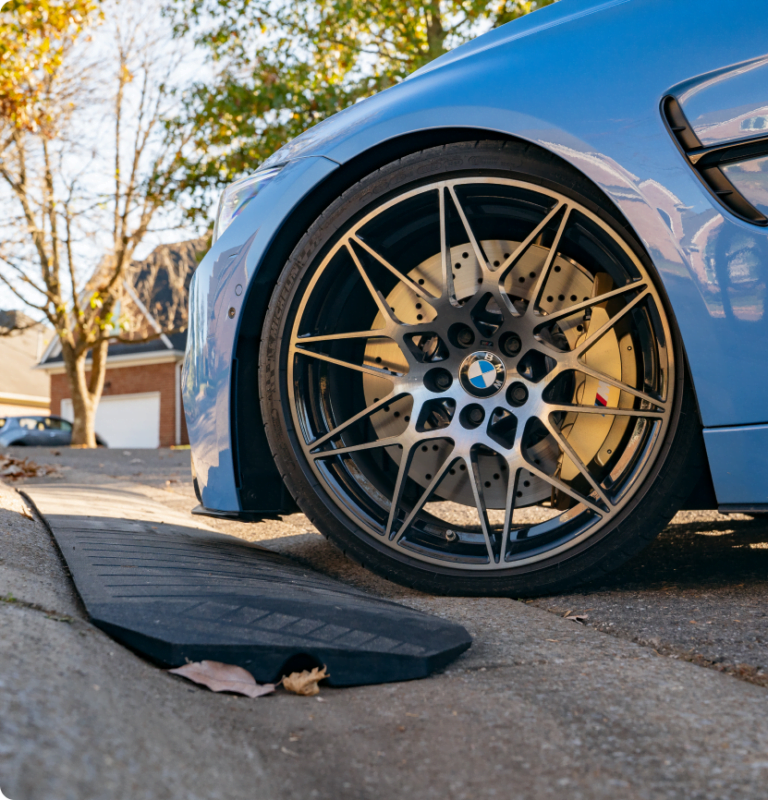
A driveway curb ramp is relevant when the tires need a smoother transition through a compatible rolled-curb gutter. It cannot flatten the driveway crest farther inside the property. Compare the actual profile and tire-path coverage using the curb-ramp measurement guide. For the buying decision, see choosing a driveway curb ramp for a lowered car.
3. Keep movement controlled and stop if clearance is uncertain
Follow your vehicle’s operating instructions and move slowly enough to remain in control. Do not use momentum to push through contact or continue because a scrape sounds minor. If the route cannot be confirmed clear, stop safely and seek help. Low speed is not proof that a vehicle will fit.
4. Have the current suspension setup assessed
Give a qualified suspension specialist the details of installed parts, the current adjustment and when the scraping started. Ask whether the configuration is appropriate for normal use and the driveway transition. Do not make arbitrary spring, spacer or ride-height changes based on a general article.
5. Check the scope before altering a curb
Do not assume grinding the curb is a simple private repair. Establish who owns or controls the curb, apron and gutter, and check local requirements before work begins. A qualified contractor should assess the transition and drainage. Changing one sharp edge may leave the actual contact point elsewhere untouched.
6. Use an existing lift feature according to its manual
If the vehicle has a factory front-axle lift or adjustable-height function, consult the instructions for that exact model and equipment. Confirm how it is activated, its operating limits and what happens as driving conditions change. Its presence does not establish that the entire underside and rear will clear. Aftermarket lift installation is a specialist decision.
7. Assess the vehicle with its normal permitted load

Record the passengers and cargo normally carried when the driveway is used. Follow the vehicle’s loading limits and instructions; do not treat a successful pass with an empty car as confirmation for all normal loads. Give this information to the person assessing clearance rather than using an unusual loading arrangement to make the driveway appear suitable.
8. Understand the limits of skid plates and lip guards
A guard is not the same intervention as changing the driveway transition or restoring suitable vehicle clearance. Before adding one, ask its manufacturer or installer how it fits your vehicle and affects the lowest point. Do not regard protection hardware as permission to continue scraping.
9. Maintain tires to the vehicle specification
Tire grip and vehicle clearance are different questions. NHTSA recommends checking cold tire pressure against the vehicle placard or owner’s manual. Do not overinflate tires to try to gain clearance. If the car has a nonstandard tire or wheel setup, ask a qualified tire professional to verify its suitability and the applicable pressure.
10. Bring useful evidence to the right specialist

For a ramp question, provide curb measurements, an overview and side-profile photo, and the normal tire paths. For a vehicle concern, provide the model, modifications, load and location of any contact. For a crest or threshold problem, ask a driveway contractor to assess that location. Keep all photos and observations clear of moving vehicles and traffic.
FAQs about lowered cars and driveways
Are there specific types of tires recommended for lowered cars on steep driveways?
Use tires approved for the actual vehicle and driving conditions. Extra grip does not establish clearance at a driveway transition. Follow the applicable tire-pressure guidance, and have nonstandard wheel or tire combinations checked by a qualified professional.
What role does vehicle weight distribution play in preventing scraping?
Load is part of the configuration that should be assessed. Follow the vehicle’s loading instructions and evaluate the driveway for normal permitted use; an unloaded pass does not confirm that every passenger and cargo combination will clear.
How do I measure my car’s ground clearance?
A parked measurement records a gap at one position; it does not establish clearance throughout entry and exit. Use the vehicle manual for reference and have a technician identify the actual lowest points on a modified car. Do not crawl beneath an unsupported vehicle to measure. Record the curb and driveway profile separately.
Choose the next step for your setup
If contact is at a suitable rolled curb, compare the Smooth Curb driveway curb ramp with your measurements and review the assembly and placement instructions. If contact is at the driveway crest or the vehicle setup is uncertain, get that issue assessed first.
For help interpreting a curb profile, contact Smooth Curb with your photos and measurements. A clear description of the car, curb and contact location is the starting point for a useful fit discussion.