

Blog
5 Types of Curbs Explained: Barrier, Rolled, Mow & More
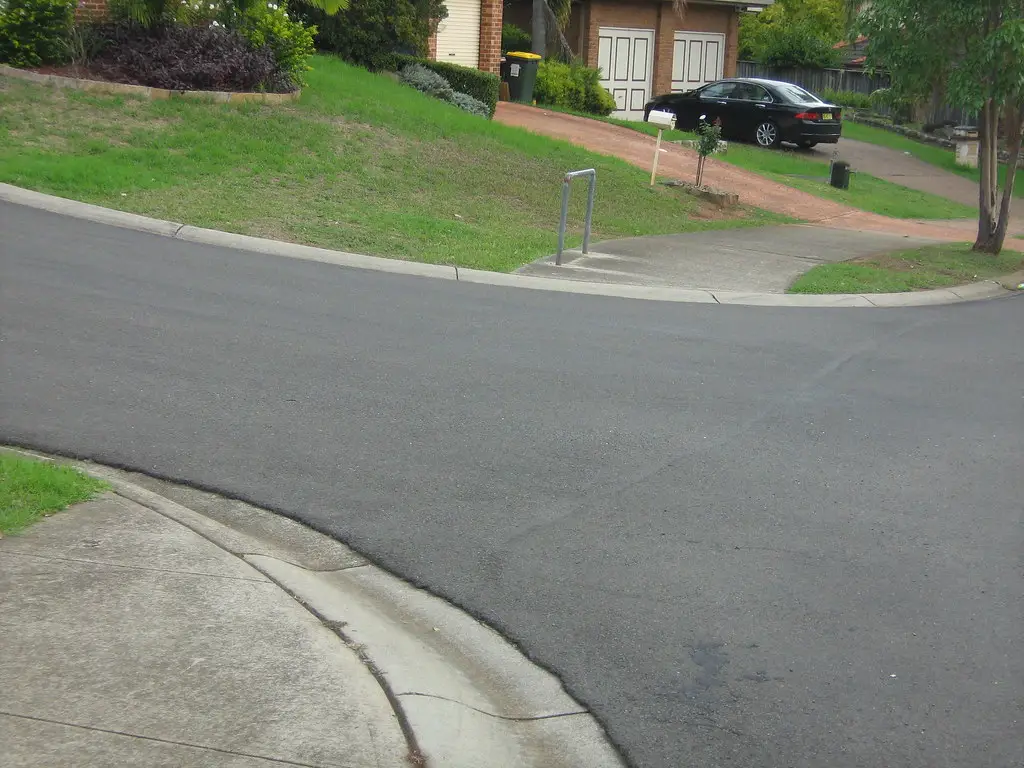
There are five main types of curbs: barrier curbs, rolled (mountable) curbs, monolithic (integral) curbs, sloped curbs, and mower curbs. Each has a different height, profile, and purpose — and they don’t all affect your car the same way. If you’ve ever scraped your bumper pulling into a driveway or felt your car bottom out over a gentle curb, the type of curb in front of your house matters more than you think.
Curb Types at a Glance
Before diving in, here’s a quick comparison of all five types plus the common curb-and-gutter combination:
| Curb Type | Height Range | Profile | Best For | Vehicle Impact |
|---|---|---|---|---|
| Barrier (Vertical) | 6–10 inches | Straight vertical face | Urban streets, arterials | High — bumper and tire damage if contacted |
| Rolled (Mountable) | 4–6 inches | Curved, gradual slope | Residential streets | Moderate — bottoming out and undercarriage scraping |
| Monolithic (Integral) | 6–8 inches | Flush with pavement, no joint | Commercial zones, high-traffic roads | Similar to barrier — not meant to be driven over |
| Sloped | 4–6 inches | Shallow angled face | Upscale neighborhoods, landscape borders | Low to moderate — angle reduces direct impact |
| Mower | 2–4 inches | Flat top, low profile | Parks, gardens, landscape edging | Minimal — not a typical vehicle concern |
| Curb and Gutter (Combined) | 6–8 inches | Curb integrated with drainage gutter | Suburban and urban streets | High — functions like a barrier curb |
1. Barrier Curbs (Straight/Vertical Curbs)
Barrier curbs are the most common curb type in cities and along arterial roads. They stand 6 to 10 inches tall with a near-vertical face — designed specifically to keep vehicles on the roadway and prevent them from accidentally mounting the curb.
The vertical profile is intentional. Engineers use barrier curbs where pedestrian safety is the top priority: downtown corridors, busy intersections, and anywhere vehicle encroachment onto the sidewalk would be dangerous.
For car owners, barrier curbs are the most unforgiving. Even brushing one at low speed can scrape a bumper cover or crack a wheel. They’re not designed to be driven over — and that standard curb height of 6 inches is enough to cause real damage on a car with low ground clearance.
Key characteristics of barrier curbs:
- Height: 6–10 inches
- Face angle: Near-vertical (80–90 degrees)
- Material: Typically cast-in-place concrete or precast concrete
- Location: Urban streets, highways, commercial districts
- Purpose: Vehicle containment and pedestrian protection
2. Rolled (Mountable) Curbs
Rolled curbs — also called mountable curbs — have a curved, sloping face rather than a vertical drop. They stand 4 to 6 inches tall and are designed to allow vehicles to roll over them at low speeds without damage to the road infrastructure.
You’ll find rolled curbs almost exclusively in residential neighborhoods. The logic is that low-traffic streets don’t need hard containment — homeowners need to cross the curb to access driveways, and a gentle slope makes that easier than a full vertical drop.
Here’s the problem: “designed to be driven over” doesn’t mean “safe for your car.” The curve still creates a significant elevation change. Cars with sporty suspension, lowered ride heights, or long wheelbases can easily bottom out on a rolled curb — especially when approaching at an angle. The damage shows up as undercarriage scraping, cracked splitter lips, and worn-down front air dams. In some cases the damage accumulates gradually: small scrapes every time you pull in, until one day the exhaust or oil pan takes a real hit.
This is actually the most insidious curb type for car owners precisely because people assume the sloped shape makes it harmless. It doesn’t. The shape protects the road infrastructure from vehicle damage — it doesn’t protect your car from the curb.
Key characteristics of rolled curbs:
- Height: 4–6 inches
- Face angle: Curved/rounded slope
- Material: Concrete
- Location: Residential streets, suburban neighborhoods
- Purpose: Traffic calming with driveway accessibility
3. Monolithic (Integral) Curbs
Monolithic curbs — sometimes called integral curbs — are poured as a single continuous unit with the street pavement. There’s no joint between the curb and the road surface, which gives them two major advantages: exceptional durability and zero water intrusion at the base.
Traditional curbs are poured separately from the pavement and then placed together, creating a joint. That joint is a weak point — water gets in, freezes, and eventually causes cracking and separation. Over years of freeze-thaw cycles, that joint breaks down and the curb can shift or heave. Monolithic curbs eliminate that vulnerability entirely because the curb and road move as one unit.
You’ll see monolithic curbs in high-traffic commercial zones, industrial areas, and on roads that take heavy loads. They’re not the norm in residential neighborhoods because they’re more expensive and complex to construct. From a vehicle standpoint, they function similarly to barrier curbs — the vertical or near-vertical face means they’re not meant to be driven over.
Key characteristics of monolithic curbs:
- Height: 6–8 inches
- Construction: Single pour with pavement — no seam or joint
- Material: Concrete (same batch as the pavement)
- Location: Commercial zones, high-load roads
- Purpose: Maximum durability and drainage integrity
4. Sloped Curbs
Sloped curbs have an angled face — not vertical like a barrier curb and not rounded like a rolled curb, but a flat, shallow incline. They’re typically 4 to 6 inches tall and serve a mostly aesthetic function.
Upscale subdivisions and master-planned communities often use sloped curbs to achieve a cleaner, more refined streetscape. Landscape architects also specify them as border edging along garden beds, medians, and decorative planting areas.
In terms of vehicle impact, sloped curbs are less aggressive than barrier curbs — the angled face distributes the contact point more gradually. That said, they’re still tall enough to damage low-clearance cars at driveways, and the angle alone doesn’t protect your undercarriage if you’re hitting them at speed or at a sharp angle.
Key characteristics of sloped curbs:
- Height: 4–6 inches
- Face angle: Shallow, flat incline
- Material: Concrete, sometimes decorative stone or brick
- Location: Upscale neighborhoods, medians, landscape borders
- Purpose: Aesthetic delineation
5. Mower Curbs
Mower curbs are the smallest and most specialized of the five types. Standing just 2 to 4 inches tall with a flat top surface, they exist for one reason: to give lawn mower wheels a level surface to ride on so the blade can cut right up to the edge of a planting bed or grass line without scalping the turf.
You’ll find mower curbs in parks, golf courses, municipal gardens, and residential landscape installations where clean grass edging matters. They’re not a street curb — they’re a landscaping tool.
From a vehicle perspective, mower curbs are essentially a non-issue. Their low profile and context (parks, gardens) means cars rarely encounter them at driveways. If you have mower curbs lining a garden bed in your yard, they’re not your car problem.
Key characteristics of mower curbs:
- Height: 2–4 inches
- Top surface: Flat, wide enough for mower wheel
- Material: Concrete, plastic, or rubber
- Location: Parks, gardens, landscape borders
- Purpose: Lawn mowing efficiency, landscape edging
How Each Curb Type Affects Your Car
Not all curbs are equally dangerous to your vehicle. Here’s what you’re actually risking with each type:
Barrier Curbs: The Obvious Hazard
The vertical face of a barrier curb means there’s no gradual transition — just a hard right angle between the road and the curb. If you contact one with your bumper at low speed, you’re looking at scraped paint, cracked bumper covers, and potential wheel or tire damage. At driveways with barrier-style curbs, the steep drop-off angle on re-entry is where most of the damage happens.
If your driveway curb is too high, you’re dealing with a barrier curb problem. The hard edge catches the front bumper or undercarriage on the way in and the rear bumper on the way out.
Rolled Curbs: The Sneaky Hazard
This is where most undercarriage damage actually happens — and most car owners never see it coming. Because rolled curbs are designed to be driven over, people assume they’re safe. They’re not safe for lowered cars, sports cars, sedans with long wheelbases, or anything with aftermarket body kits.
Car bottoming out on a rolled curb is especially common when the approach angle is off. Coming in straight is manageable; coming in at a diagonal creates a diagonal crossing of the curb’s elevation change — and that’s when the front corner of your undercarriage takes the hit.
If you’ve ever heard that grinding or scraping sound pulling into your driveway, you already know what scraping the bottom of your car on the driveway feels like. Rolled curbs are usually the culprit.
Monolithic and Sloped Curbs
Monolithic curbs behave like barrier curbs from a vehicle impact standpoint. The seamless construction doesn’t change the profile — it’s still a tall, vertical or near-vertical face that your car shouldn’t be mounting.
Sloped curbs are more forgiving because the angle distributes contact more gradually. That said, they’re still tall enough to catch low-profile vehicles, particularly at driveway transition points where the curb meets a residential apron.
The Fix for Any Curb Type
Regardless of curb type, if your driveway entry is causing damage, a properly fitted curb ramp bridges the gap between the road and your driveway apron — eliminating the angle that causes scraping and bottoming out. It works on barrier curbs, rolled curbs, and everything in between.
Which Curb Type Do I Have?
Stand at the street in front of your driveway and look at the curb from the side. Here’s how to identify what you’re dealing with:
- Vertical or near-vertical face, 6 inches or taller: Barrier curb. The face drops almost straight down from the top of the curb to the road surface.
- Curved, gradual slope, 4–6 inches tall: Rolled (mountable) curb. The face curves outward and blends into the road more gently.
- No visible seam between curb and pavement: Monolithic curb. The curb and street appear to be one continuous pour.
- Flat angled incline, more decorative appearance: Sloped curb. Common in newer subdivisions with landscaped medians.
- Very low profile (under 4 inches), flat top: Mower curb. Almost certainly a landscaping context, not a street curb.
If you’re still not sure, check when your neighborhood was built. Rolled curbs became the standard for residential streets in the mid-20th century and remain common today. Barrier curbs dominate anything built along a busier road or in a city core. Monolithic curbs show up in commercial and industrial construction. When in doubt, run your hand along the face of the curb — a vertical or near-vertical drop is a barrier curb; a smooth curved transition is a rolled curb.
Frequently Asked Questions
What are the different types of curbs?
The five main types of curbs are barrier curbs (vertical), rolled curbs (mountable), monolithic curbs (integral), sloped curbs, and mower curbs. A common variation is the curb-and-gutter combination, which integrates the curb with a drainage channel. Each type has a different height, face profile, and intended use case.
What is the most common curb type?
Barrier curbs are the most common curb type in urban and suburban environments. In residential neighborhoods specifically, rolled curbs are extremely common — most subdivision streets built after World War II use mountable curb profiles to allow driveway access without full curb cuts at every home.
What is a rolled curb?
A rolled curb is a curb with a curved, sloping face designed to allow vehicles to drive over it at low speeds. Also called a mountable curb, it stands 4 to 6 inches tall and is standard on residential streets. The rounded profile reduces the hard edge that would otherwise make curb crossing damaging to road infrastructure — but it doesn’t eliminate the risk to your car’s undercarriage.
Do rolled curbs damage cars?
Yes. Despite being designed to be driven over, rolled curbs regularly cause undercarriage scraping, front splitter damage, and bottoming out — especially on lowered vehicles, sports cars, and sedans with long wheelbases. The curved profile still creates a 4–6 inch elevation change, and if you approach at an angle rather than straight on, the geometry of that crossing gets much worse. Many drivers don’t realize their rolled curb is the source of their driveway damage because the slope looks gentle.
What is the difference between a barrier curb and a rolled curb?
The key difference is face angle and intent. A barrier curb has a near-vertical face and is designed to physically prevent vehicles from leaving the roadway — it’s a hard stop. A rolled curb has a curved, sloping face and is designed to allow vehicles to cross it at low speed. Barrier curbs are taller (6–10 inches vs. 4–6 inches for rolled) and far more aggressive on contact. Both can damage your car at driveway crossings, but in different ways — barrier curbs tend to cause bumper and tire damage, while rolled curbs cause undercarriage scraping and bottoming out.
What type of curb is best for driveways?
From a vehicle-friendliness standpoint, rolled curbs are the best option for driveways — their sloped profile allows crossing without a full curb cut. However, “best” in practice depends on local municipal codes, not homeowner preference. Most municipalities specify curb type based on road classification. If your existing curb is causing damage, the practical solution isn’t changing the curb — it’s adding a properly sized curb ramp that bridges the transition between road and driveway.
Conclusion
The five types of curbs — barrier, rolled, monolithic, sloped, and mower — each serve a different purpose and create different risks for vehicles at driveway crossings. Barrier curbs are the hardest on cars physically; rolled curbs are the most deceptive because people assume their gentle slope makes them harmless.
If you’re dealing with a driveway that’s causing scraping or bottoming out, the curb type is the starting point for diagnosing the problem. But the solution is the same regardless of type: a properly rated curb ramp that transitions your car smoothly from street level to driveway level without the angle that causes damage.
The Smooth Curb driveway curb ramp is engineered specifically for this — built to handle the daily load of real vehicles and sized to work with the most common residential curb heights. If your driveway entry is causing damage, it’s the straightforward fix.