

Blog
What Is a Rolled Curb? How to Identify One at Your Driveway

A rolled curb is a curb with a rounded, sloping face that rises from the street or gutter toward the surface behind it. At a driveway entrance, it creates a transition for vehicle tires to cross. Unlike a vertical curb, it does not present a mostly upright step.
Rolled curbs belong to the broader family of sloping or mountable profiles. The names used in local drawings vary, so check the actual shape at your driveway. A rounded face can still be a difficult transition for a low car, and the label alone cannot tell you whether a particular ramp will fit.
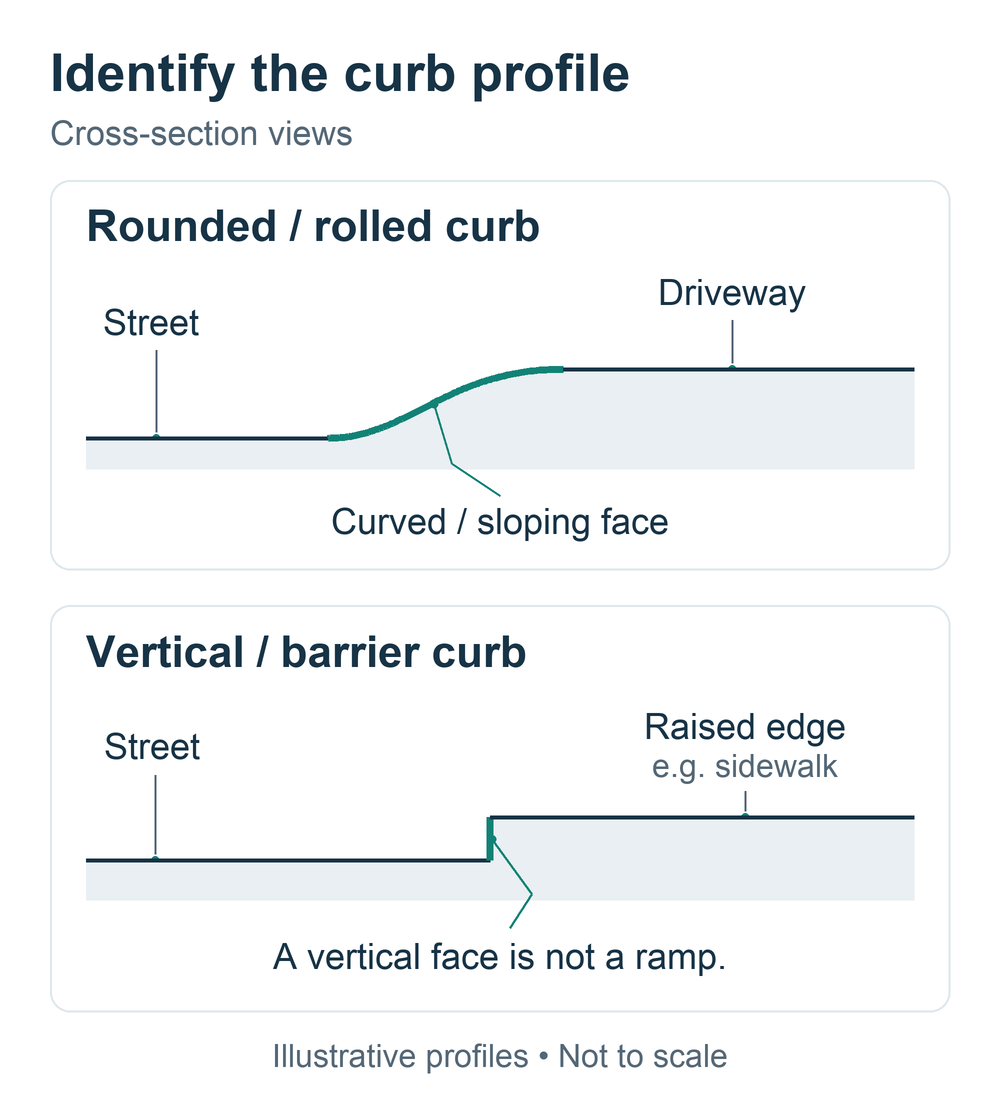
Rolled curb vs. vertical curb
The useful distinction is the side profile, not whether the curb follows a straight line along the street:
- Rolled curb: a rounded rise that lets a tire travel up the face at an intended crossing.
- Vertical or barrier curb: an upright or nearly upright face separating the road from a raised edge.
- Sloping or mountable curb: a broader description for a curb with a traversable slope. Some profiles are rounded; others have a flatter sloped face.
The Federal Highway Administration’s curb design guidance distinguishes vertical and sloping designs and explains that sloping curbs are easier for vehicles to cross. That distinction is not a promise that every car will clear every sloping curb. For materials, gutter arrangements and other names, see our guide to the different types of curbs.
How to identify a rolled curb
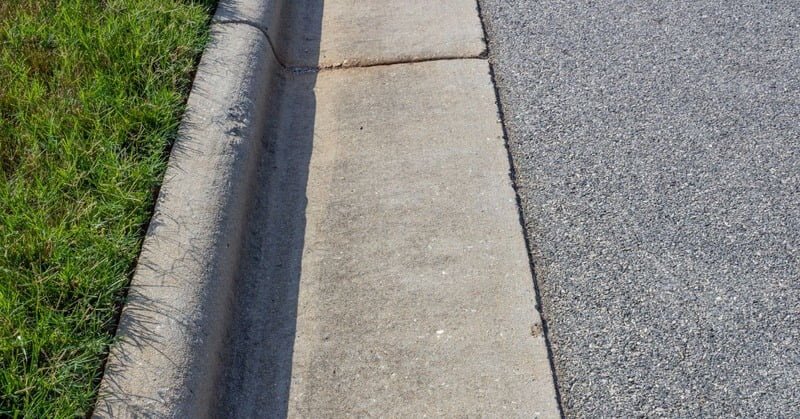
Look at your entrance from the side, where you can see the rise from the street gutter toward the driveway. A rolled profile curves upward instead of forming a vertical face. Check the whole width of the entrance: wear, repairs and changes in pavement level can make one tire path different from the other.
A rounded transition may be easier to cross than an upright edge, but curb shape alone does not establish vehicle clearance or accessibility. If the curb is lowered or nearly flush at the driveway, the problem may instead be a small lip, a gutter dip or a slope change farther up the driveway.
What does the gutter do?
The gutter is the channel along the roadway beside the curb. It carries runoff toward drainage outlets. A rolled curb does not inherently cause pooling: the gutter’s grade, outlet condition and obstructions also matter. Keep the water path clear when considering a ramp; a ramp is not a repair for a drainage problem.
Why a car can scrape at a rolled curb
Your tires can climb a rounded curb while a lower part of the car contacts the surface. Clearance depends on the curb rise and shape, the adjoining slopes, and the vehicle’s ground clearance, wheelbase and overhangs. A rounded appearance does not guarantee a gentle crossing for your particular vehicle.
Start by locating the contact point. Scraping at the street curb is different from the middle of the car touching a driveway crest or a bumper meeting a garage threshold. See our guide to diagnosing driveway scraping before choosing where a ramp should go.
When a driveway curb ramp can help
A properly matched curb ramp adds a transition at the street-side curb. Smooth Curb’s driveway curb ramp is designed for rolled-curb entrances. The standard three-section kit spans 12 feet along the curb, with a 17-inch front-to-back depth and 3-inch product height. These are product dimensions, not a universal allowable curb height.
Fit depends on how the ramp meets your full curb profile, the available gutter space and the area your tires cross. A vertical step, unusual gutter or separate driveway crest needs its own assessment. The ramp’s drainage channel provides a path for water, but it cannot guarantee drainage at every site.
Measure your curb before choosing a ramp
- Take a side-view photo. Show the street, gutter, curb face and start of the driveway together.
- Measure the transition. Record the curb rise, available front-to-back space and width along the curb that your tires use.
- Note changes along the entrance. Include uneven pavement, drainage outlets and any difference between the two tire paths.
- Compare the profile before ordering. Use our driveway curb ramp selection and measurement guide, or send your curb photos and measurements to our team.
Once fit is confirmed, follow the Smooth Curb installation guide for joining and positioning the sections.
Why cities build rolled curbs in the first place
Rolled curbs are not a mistake, even if they feel like one from the driver’s seat. Municipalities and developers choose them because they carry stormwater along the gutter without a hard edge, they cost less to form than a vertical curb, they let any lot become a driveway later without cutting the curb, and they look continuous along a residential street. Those are real advantages for the street. The trade-off lands on the homeowner with a low car, because the same rounded profile that lets water and trucks roll over it is a hump that a front bumper has to clear twice a day.
Newer subdivisions increasingly use mountable curbs with a shallower profile, tapered driveway aprons, or flat-to-slope entries, and some cities will approve a curb cut on request. Those fixes are permanent and involve the city. A ramp is the option that does not.
What repeated contact at a rolled curb does over time
A single hard hit is obvious. The damage that builds up from crossing the same curb a few hundred times a year is not, and it shows up in three places.
- The car. Each scrape takes a little undercoating off the underbody and exposes metal to corrosion. Each jolt loads the tires, wheel bearings, tie rods and ball joints. Over months this shows up as a steering wheel that sits slightly off-center, a pull to one side, or tires wearing on one edge. If you already have those symptoms, start with the alignment guide.
- The driveway. Repeated contact at the same spot chips concrete and asphalt at the transition, cracks follow, and water gets in. In freeze-thaw climates the cracks grow every winter.
- Everything on the way in. Drivers who brace for the hump tend to hit it faster or straighter than they should, which is what triggers the stability-control warning some owners report, and which puts the load through the suspension instead of the tires.
Crossing a rolled curb with the least impact
Until the curb transition is dealt with, the technique that does the least harm is the boring one. Slow to a crawl before the front wheels reach the gutter, so the suspension is settled rather than compressing. Take the curb slightly on the diagonal so one front wheel climbs before the other, which halves the effective step. Keep tire pressures at the door-placard figure; underinflated tires let the rim get closer to the edge. Do not accelerate through it, and do not correct the wheel while the front is on the hump. New drivers get this wrong mostly by speed, not by line.
Rolled curb questions
Are rolled curbs and mountable curbs the same?
The terms overlap. Mountable describes a sloping profile that vehicles can cross where intended; rolled usually describes a rounded version. Compare the actual cross-section rather than relying on the name.
How high is a rolled curb?
There is no single height that describes every rolled curb. Measure your own entrance and consider the full shape. A ramp’s listed height does not, by itself, establish compatibility with your curb.
Will a rolled-curb ramp fix every driveway scrape?
No. A curb ramp addresses the transition where it is installed. It does not change a separate driveway crest or garage lip. Identify the contact point, then check the proposed ramp against your curb and vehicle clearance.