

Blog
Curb Ramp Fit for Trailers, Boats, RVs, Vans, Golf Carts and Motorcycles

A trailer and its tow vehicle can follow different paths across a driveway entrance. A curb ramp may help at a compatible rolled-curb transition, but the complete loaded setup needs enough clearance and tire-path coverage. A vehicle-only measurement is not enough.
A ramp is not a trailer stability device, hitch safeguard or guarantee against cargo or animal injury. Towing setup, loading, ratings and operating procedures remain governed by the vehicle, trailer and equipment manufacturers.
Table of Contents
Check the trailer and tow vehicle together
1. Locate the contact point
Record whether contact occurs at the street curb, farther up the driveway or near the garage. Include low trailer components, rear overhang and the hitch area in the description. Do not repeatedly scrape the setup to test its limits. A curb ramp at the gutter does not alter a separate crest.
2. Record both sets of tire paths
Measure the span crossed by the tow vehicle and trailer when entering and leaving, including the turn. Note where either set of tires approaches the end of the proposed ramp. Plan observation from a safe location clear of the moving combination; stop if clearance or visibility is uncertain.
3. Check the actual loaded configuration
Use the configuration in which the trailer is operated: hitch setup, intended load and applicable axle, tire and towing limits. A ramp’s published capacity does not approve a load distribution or establish clearance for the trailer, hitch or tow vehicle.
4. Resolve equipment problems separately
A loose hitch connection, damaged suspension, tire problem or unstable trailer needs the appropriate equipment inspection and correction. We do not claim that a curb ramp prevents sway, tipping, detachment, bent axles or suspension wear.
5. Avoid assumptions based on trailer type
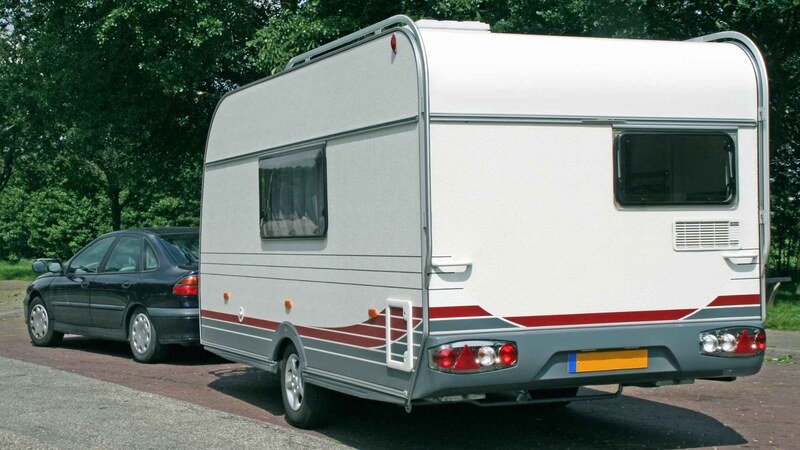
Boat, utility, RV and horse trailers differ in geometry, loads and intended handling. Another owner’s successful crossing does not establish fit for yours. A driveway curb ramp is also different from a boat-launch ramp, cargo-loading ramp or animal-loading ramp.
Compare the curb profile and coverage
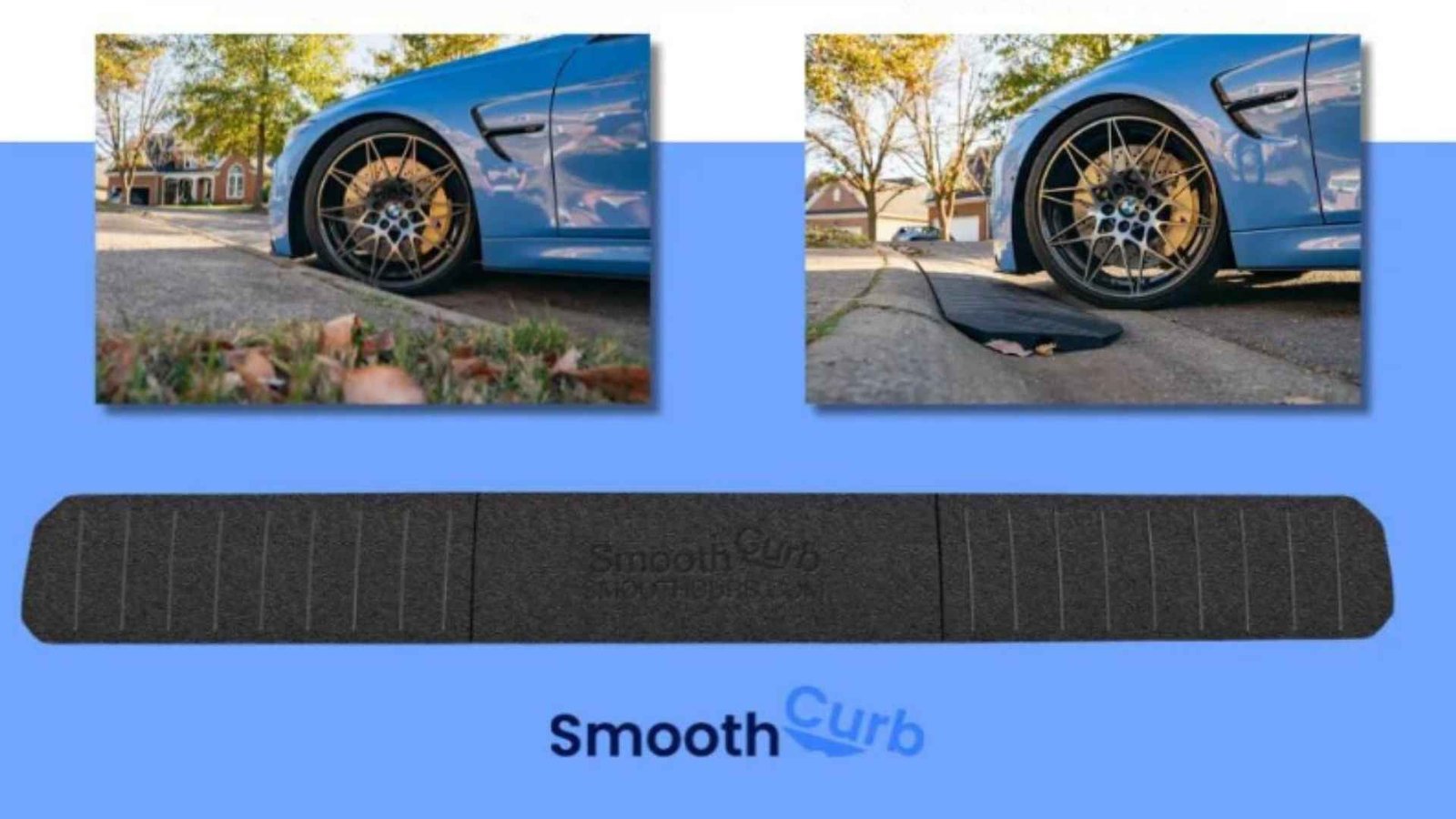
Before choosing coverage for a trailer, use the driveway curb ramp fit and measurement guide to check the curb profile and the tire paths of both the towing vehicle and trailer. The standard system spans 12 feet along the curb; each 4-foot center extension adds coverage in that same direction. Extensions do not make the ramp taller or lengthen its front-to-back transition, and clearance must still be checked for your setup.
Smooth Curb’s standard dimensions are 144 inches along the curb, 17 inches front to back and 3 inches high. These are product dimensions, not an approved range for every curb or trailer. For pronounced curves, uneven ground, a vertical curb or uncertain clearance, ask for a fit review before ordering.
Keep the gutter and ramp channel clear and follow the assembly instructions. Do not assume that any material is universally legal or illegal, or that rubber automatically guarantees placement, durability or trailer safety. Confirm local placement requirements for the actual location.
Prepare a useful fit request
- Side-view photos of the curb and driveway, plus measurements of the profile and available space.
- Tow-vehicle and trailer details, the intended loaded configuration and the lowest relevant components.
- Entry and exit tire paths, turning direction and the location of any previous contact.
Send those details to Smooth Curb for product fit help. Use the appropriate vehicle or trailer professional for towing setup and mechanical questions.
Trailer fit questions
Do extensions increase trailer clearance?
Extensions add coverage along the curb. They do not make the ramp taller or deepen the transition; your combination’s clearance still needs checking.
Does a 32,000-pound capacity mean any trailer will fit?
No. The published capacity is a load specification, not proof of clearance, support or compatibility with every towing setup.
How should I relocate the ramp?
Follow the FAQ: disconnect the connecting bolts before moving sections and arrange help handling them. Check the placement and connections again before use.
Fit notes by vehicle type
The checks above apply to anything you tow or drive over the curb. These are the extra things that matter for each type, drawn from the fit requests we see most.
Boat trailers
The low points are usually the trailer frame behind the axle, the outboard skeg or a stern drive hanging past the transom, and the hitch area under the tow vehicle. Check the trailer in its towing configuration with the boat strapped down, because a bunk trailer sits differently loaded than empty. Suspension type matters too: torsion axles flex less than leaf springs over a hump. A curb ramp is not a launch ramp and does not stand in for the trailer’s brakes, hitch or tie-downs.
RVs and motorhomes
Weight is the first check. Class B vans run roughly 8,000 to 14,000 pounds, Class C 12,000 to 20,000, and Class A up to 30,000 or more, so a ramp rated for a car will not do; Smooth Curb’s rating is up to 32,000 pounds for the assembled system. The second check is the rear overhang, which on a Class A can be ten feet or more and drags the tailpipe, the holding-tank drains and the rear steps as the front climbs the curb. Plastic ramps in the 500 to 1,000 pound range and light metal ramps are not candidates here, and asphalt fill compresses under this weight.
Vans and camper vans
Vans scrape at the front bumper, between the axles on long-wheelbase models, and at the rear where steps, hitches and body conversions hang low. Measure with the van loaded the way you actually drive it; a conversion with water, batteries and gear can sit an inch or more lower than the same van empty. Include the swing of the tire path on the turn in and out, which is wider on a long van than the driveway suggests.
Golf carts and LSVs
Carts are light, so load is not the issue; geometry is. Lifted carts with larger tires clear easily; stock and lowered carts with small tires can hang the front bumper or battery tray on a rolled curb. When you send a fit request, include make, model and year, any lift or tire change, tire outside diameter, and the front and rear wheel spacing, plus the usual side-view curb photos. Check HOA and municipal rules for carts on the street separately from ramp placement rules.
Motorcycles
For a bike the question is less about clearance than control. Low pipes, fairings, footrests and side stands can touch on a steep rolled curb, especially on a turning approach. Rubber texture helps grip but is not a guarantee when wet, so treat the ramp like any other surface change: slow, upright, no abrupt throttle or brake on it. Plan coverage for the line you actually ride into the driveway, including the turn, not just the straight-in width.